

On 27th April 2026, the Faculty of Public Health (FPH) Global Health Committee (GHC) Away Day brought together the chairs of the Faculty’s international-facing geographic and thematic Special Interest Groups (SIGs), GHC leads, and wider stakeholders. The core objective of the day was to review the successes and challenges of the 2022–2025 planning period, and to strategically plan the GHC’s contribution to the FPH Strategy for 2025–2030.
We do not exist in a vacuum
Opening the day Professor Tracy Daszkiewicz delivered a challenge that should reshape how we think about modern public health practice: we do not exist in a vacuum.
Too often, “global health” is treated as a specialist interest, something separate from the realities of local authority work, health protection, health improvement, or healthcare public health. But in an interconnected world defined by conflict, climate change, migration, pandemics, and economic instability, that distinction no longer holds.
As Professor Daszkiewicz reflected, “we are living in a period of sustained instability across the world.” Armed conflicts, humanitarian crises, forced displacement, fragile health systems, and climate change are not distant issues happening elsewhere. They directly shape the pressures facing communities here in the UK.
We see this every day in local public health practice. International crises increasingly translate into local challenges: supporting newly resettled communities affected by conflict and displacement; responding to emerging infectious diseases; managing medicine and supply chain disruptions; preparing for climate-related health threats; tackling antimicrobial resistance; and addressing widening inequalities intensified by global economic instability. These are no longer hypothetical “global” issues occurring elsewhere, they are shaping the lived realities of local communities across the UK.
The lesson is clear: local public health cannot be practised effectively without understanding the global forces shaping health.
The collapse of the “local” versus “global” distinction
COVID-19 exposed what public health professionals have long known: health threats do not respect borders.
Professor Daszkiewicz reiterated a truth that became painfully visible during the pandemic: “none of us are safe until all of us are safe.”
This principle extends far beyond infectious disease. A drought affecting food systems overseas can influence food insecurity in UK communities. Conflict-driven displacement reshapes local service needs. Climate emergencies intensify both global and domestic inequalities simultaneously.
For public health professionals, this means that a global lens is no longer optional. It is essential infrastructure for competent local practice.
Importantly, this is not about becoming an “international expert.” It is about recognising that every practitioner, whether working in local government, the NHS, academia, or the voluntary sector operates within an interconnected system. If we only focus on our local piece of the puzzle, we limit our capacity to learn, adapt, and respond effectively to increasingly complex challenges.
Moving beyond one-directional models toward professional solidarity
One of the most important challenges raised during the Away Day was the need to rethink how we frame global health itself.
Too often, global health can unconsciously be approached as a one-directional transfer of expertise, where learning is assumed to flow primarily from high-income countries outward. Professor Daszkiewicz instead called for something far more meaningful: professional solidarity.
This matters because effective global health practice is fundamentally reciprocal. Some of the most innovative approaches to community engagement, prevention, resilience, and health system adaptation are emerging from countries working under immense pressure and constraint. Whether through outbreak management, community mobilisation, or delivering care within resource-limited settings, there is enormous expertise to learn from globally.
For UK public health professionals, this means recognising that international engagement is not separate from local practice. The experiences of other countries can directly inform how we support newly resettled communities, strengthen local resilience, respond to emergencies, and address widening inequalities here at home. Equally, the UK has important learning and expertise to contribute in return.
This shift toward mutual learning requires humility, curiosity, and collaboration. It challenges us to move beyond siloed thinking and toward a model of public health rooted in partnership and shared learning across borders.
Embedding global health as a golden thread through the future curriculum
The Faculty’s curriculum review ahead of the 2027 intake presents a critical opportunity to future-proof the public health workforce. But if we are serious about preparing practitioners for the realities of modern public health, global health cannot remain confined to a standalone module, optional placement, or niche interest area. It must become a golden thread running throughout the curriculum itself.
Why? Because the distinction between “local” and “global” public health is becoming increasingly artificial.
The challenges practitioners are already navigating in UK communities, climate-related health risks, migration and resettlement, widening inequalities, emerging infections, antimicrobial resistance, workforce pressures, and supply chain disruption, are all shaped by global systems and international events. Tomorrow’s public health workforce will need to understand not only epidemiology and health protection, but also interconnected systems, humanitarian contexts, geopolitical instability, and the social, political, and economic determinants of health operating across borders.
Crucially, we must also recognise the limits of trying to design a curriculum purely around today’s challenges. Ten years ago, few could have predicted the scale of disruption caused by COVID-19, the acceleration of climate emergencies, or the complexity of the humanitarian and geopolitical pressures now shaping population health. If public health operates within a world of sustained instability, then our training programmes must equip practitioners not only with technical competencies, but with the adaptability, systems thinking, cultural humility, and ethical leadership needed to respond to an uncertain future.
Embedding global health throughout the curriculum is therefore not about creating more content for trainees to memorise. It is about shaping a mindset: one that understands that no community exists in isolation, that meaningful solutions require collaboration across borders and sectors, and that learning must flow in multiple directions.
Breaking out of silos: a practical call to action
Alongside curriculum reform, we also need stronger opportunities for connection and shared learning across the profession. Too often, practitioners working on fundamentally connected issues remain separated by organisational, geographical, or specialty silos.
Yet many professionals are already engaging in global health work without necessarily recognising it as such: supporting refugee and asylum-seeking populations, responding to climate adaptation challenges, managing health protection threats, addressing workforce migration, or tackling inequalities shaped by international economic pressures. The work is already happening, but too often in isolation.
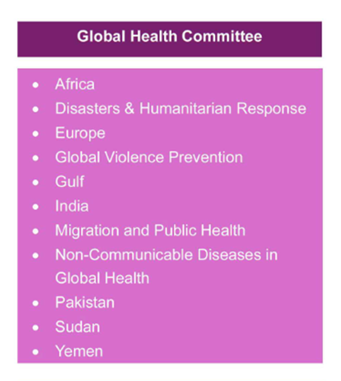
If we want a workforce capable of responding to the realities of the next decade, we need more spaces where practitioners can exchange learning across specialties, sectors, and borders. Special Interest Groups (SIGs) that fall under the umbrella of the Global Health Committee’s provide one practical route for doing this creating opportunities for collaboration, peer learning, and collective problem-solving at a time when no area of public health can afford to operate n isolation.
Professor Daszkiewicz also reflected on an often-overlooked aspect of crisis response: recovery. While emergency responses frequently mobilise energy and attention, she reminded us that “the humanitarian aspect of recovery is absolutely vital.” Ultimately, the true measure of success is “how well we leave the place and its people resilient.”
That principle applies equally to our profession.
If public health is to remain effective in an era of sustained instability, we cannot retreat into outdated distinctions between “local” and “global” health. We need a workforce capable of learning across borders, adapting rapidly to change, and acting in solidarity with communities both locally and globally.
The curriculum review gives us a rare opportunity to embed those principles now, before the next global crisis forces us to relearn them again.